
Some roads are designed for everyday commuting. Others are built to test everything a vehicle and driver have. Across the world, vehicles for challenging terrain must deal with scorching deserts, steep mountain passes, muddy forests, flooded tracks, rocky trails, gravel roads and remote rural routes. These environments demand much more than engine power. Traction, ground clearance, durable suspension, reliable cooling, strong braking and dependable drivetrain capability can all become essential.
For international buyers, choosing the right vehicle becomes even more important. A vehicle purchased in Dubai may eventually travel thousands of kilometres to a completely different climate and terrain. From the deserts of the Middle East to mountainous regions, tropical roads and remote African or Latin American routes, driving conditions can change dramatically. Therefore, selecting the right specification before export can make a major difference when the road becomes difficult.
Whether the requirement is a capable SUV, a rugged pickup or a dependable 4WD, understanding the demands of the destination is essential. The best vehicle is not necessarily the one with the most horsepower. Instead, it is the vehicle that provides the right combination of capability, reliability, practicality and comfort for the environment where it will be used.
DESERTS, MOUNTAINS AND EXTREME TERRAIN
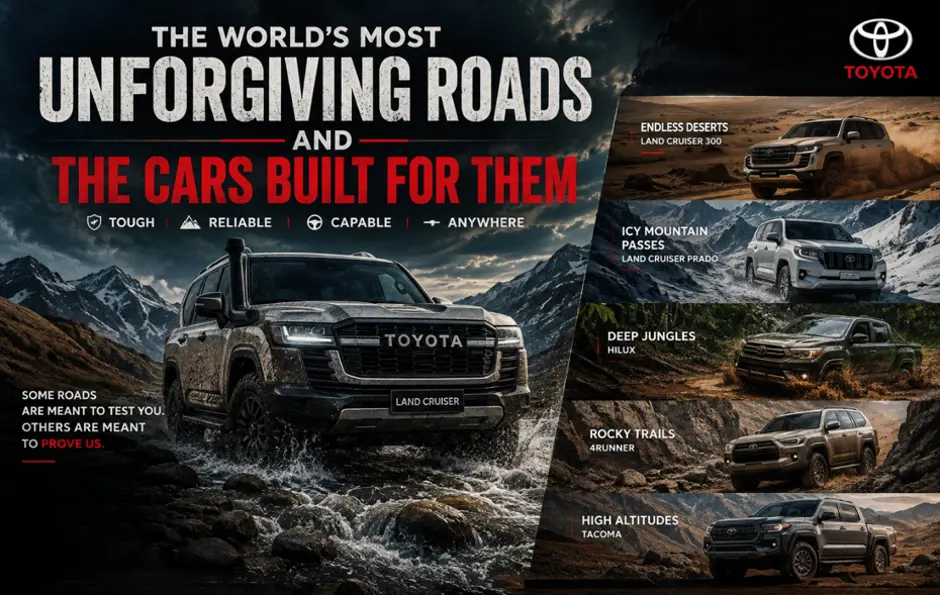
Desert driving combines extreme heat with loose and unpredictable surfaces. Deep sand can quickly reduce traction, while high temperatures place additional demands on the engine, cooling system, transmission and tires. For drivers looking for vehicles for desert driving, 4WD capability, high ground clearance, suitable tires and strong low-speed torque can provide valuable advantages.
Vehicles such as the Toyota Land Cruiser, Toyota Prado and Nissan Patrol are widely associated with demanding desert environments because they combine off-road capability with everyday practicality. Their ability to handle loose surfaces, uneven tracks and long-distance journeys makes this type of SUV particularly attractive to drivers operating in demanding climates.
However, vehicle capability is only one part of successful desert driving. Correct tire pressure, appropriate driving technique, sufficient fuel range and reliable cooling performance are also important. Drivers should understand the terrain and vehicle limitations before attempting difficult sand tracks or remote desert routes.
Mountain roads present a completely different set of challenges. Steep climbs, sharp descents, uneven surfaces, narrow roads and changing weather can place significant demands on a vehicle. At higher elevations, reduced atmospheric pressure can affect the performance of naturally aspirated engines, while steep gradients can increase the demands placed on the brakes, transmission and cooling system.
A capable mountain vehicle needs controlled power delivery, strong braking, good traction and stable suspension. In difficult terrain, predictable handling and reliability can matter more than simply having maximum horsepower. Good ground clearance is also useful when roads contain rocks, potholes, deep ruts or uneven surfaces.
Tropical roads create another challenge. Heavy rain can quickly turn dirt roads into deep mud, while standing water and slippery surfaces can make travel difficult. 4WD vehicles for difficult roads can provide additional traction, particularly when combined with appropriate tires, adequate ground clearance and effective traction-control systems.
MUD, ROCKS AND ROUGH ROADS
Mud demonstrates why horsepower alone does not determine off-road capability. Once traction disappears, additional engine power cannot always solve the problem. Appropriate tires, sufficient ground clearance, effective traction systems and controlled power delivery are essential when driving through deep or slippery surfaces.
For vehicles for challenging terrain, the relationship between the engine and drivetrain is particularly important. A vehicle needs to transfer available power to the road effectively rather than simply producing high peak horsepower. Low-speed control can be especially valuable when navigating mud, steep inclines or uneven tracks.
Rocky roads can be equally demanding. Sharp rocks, potholes, deep ruts and uneven surfaces repeatedly challenge tires, wheels, suspension components and underbody parts. Strong suspension, high ground clearance, suitable tires and underbody protection can help a vehicle handle these conditions more effectively.
Rugged SUVs and pickups such as the Toyota Land Cruiser and Toyota Hilux are often selected for demanding applications where durability and practicality are important. Their combination of passenger capacity, cargo capability and off-road characteristics makes them suitable for a wide range of personal, commercial and utility applications.
Gravel roads can also create long-term challenges. Although they may not look as extreme as rocky trails or deep mud, continuous vibration and loose surfaces can place additional stress on suspension components, tires and other vehicle systems. For long-distance users, durability and regular maintenance are therefore just as important as initial off-road capability.
AFRICA AND LATIN AMERICA: ROADS THAT DEMAND VERSATILITY
Across many African markets, a journey can quickly change from paved highways to gravel, potholes, sand and rocky tracks. For businesses, farms, construction operations and remote communities, vehicles may need to carry people and equipment over long distances while dealing with changing road conditions.
This is where versatility becomes especially important. A vehicle used for international operations may spend part of its life on highways and the rest on unpaved roads. Buyers therefore need to consider not only off-road performance but also passenger comfort, cargo capacity, fuel economy, reliability and ease of maintenance.
Latin America also offers a wide variety of terrain, from coastal highways and mountains to forests and remote rural roads. Countries such as Chile, Costa Rica, Panama and Venezuela demonstrate how quickly driving conditions can change between regions.
For international buyers searching for vehicles for challenging terrain, understanding the destination is essential. A specification that works well in a hot desert environment may not necessarily be the best option for a wet tropical region or a high-altitude mountain area.
High-altitude environments add another challenge. Reduced atmospheric pressure can affect naturally aspirated engine performance, while steep roads place additional demands on braking, transmission and cooling systems. Turbocharged engines can have advantages at altitude, but buyers should always consider the complete vehicle specification and intended application.
WHAT MAKES VEHICLES FOR CHALLENGING TERRAIN READY FOR TOUGH ROADS?
The same essential characteristics appear across many challenging environments. When choosing a vehicle for difficult roads, buyers should consider several important factors.
4WD Capability
Four-wheel drive can provide additional traction when driving on loose sand, mud, gravel and uneven surfaces. Depending on the vehicle, different 4WD systems can provide different levels of capability, so buyers should understand the drivetrain specification before purchasing.
High Ground Clearance
Ground clearance helps reduce the risk of the underbody contacting rocks, deep ruts, potholes and uneven terrain. This can be particularly important on remote roads where obstacles cannot easily be avoided.
Strong Low-Speed Torque
Low-speed torque can help a vehicle maintain controlled movement when climbing steep slopes, crossing difficult surfaces or carrying heavy loads. Smooth power delivery is often more useful in demanding terrain than simply having a high horsepower figure.
Durable Suspension
Rough roads can repeatedly challenge suspension components. A durable suspension system can help a vehicle handle potholes, gravel, rocks and uneven surfaces while maintaining stability and passenger comfort.
Reliable Cooling
Hot climates and demanding driving can increase the workload placed on the engine and cooling system. Reliable cooling performance is particularly important for vehicles operating in deserts, carrying heavy loads or travelling long distances.
Appropriate Tires
Tires are one of the most important points of contact between a vehicle and the terrain. Different surfaces require different characteristics, with suitable options available for sand, mud, gravel, rocks and mixed road conditions.
Effective Traction Systems
Modern traction systems can help manage wheel slip on slippery or uneven surfaces. These systems can work together with the drivetrain to improve control when road grip becomes limited.
Strong Braking Performance
Braking becomes particularly important on steep mountain roads and long descents. A capable vehicle needs dependable braking performance and stable handling when travelling downhill or carrying passengers and cargo.
Adequate Fuel Range
Remote roads may have limited access to fuel stations. A suitable fuel range can therefore be important for long-distance journeys, particularly in desert, rural and isolated regions.
No single feature makes a vehicle suitable for every environment. True off-road capability comes from how the engine, drivetrain, suspension, tires, braking system and chassis work together.
CHOOSING VEHICLES FOR CHALLENGING TERRAIN
There is no single vehicle that is perfect for every road. A vehicle that performs exceptionally well on Dubai’s sand dunes may not be the ideal choice for muddy tropical terrain. Similarly, a heavy-duty pickup may provide capabilities that are unnecessary for someone who primarily drives in a city.
The smartest approach is to match the vehicle to the destination and intended use. International buyers should consider climate, terrain, road conditions, passenger requirements, cargo needs, fuel availability, maintenance requirements and expected driving distances before choosing a vehicle.
For example, buyers looking for vehicles for desert driving may prioritize 4WD, ground clearance, cooling performance, tire suitability and fuel range. Buyers operating in mountainous regions may place greater importance on braking, traction, suspension and controlled power delivery.
Businesses operating on rough rural roads may require a combination of durability, passenger capacity and cargo practicality. Construction companies may prioritize payload and chassis strength, while families travelling long distances may place greater importance on comfort, safety and reliability.
Understanding the destination before purchasing is therefore one of the most important parts of selecting the right vehicle.
FROM DUBAI TO THE WORLD VEHICLES FOR CHALLENGING TERRAIN
Dubai is a major hub for international vehicle trading, connecting buyers with SUVs, pickups, 4WD vehicles and commercial vehicles for markets around the world. Its location and established automotive trading environment make it an important sourcing destination for international vehicle buyers.
Forex Motors helps international customers source vehicles from Dubai with their destination and intended use in mind. From Toyota Land Cruiser and Toyota Prado models to Nissan Patrols, Toyota Hilux pickups and other capable vehicles, Forex Motors offers vehicles suited to a wide range of applications and international markets.
For buyers exporting vehicles from Dubai, selecting the right specification is particularly important. A vehicle may travel from the UAE to a market with different temperatures, road surfaces, fuel availability and maintenance requirements. Considering these factors before purchase can help buyers choose a vehicle that is better suited to its eventual destination.
Whether the destination involves deserts, mountains, forests, highways, gravel roads or challenging rural routes, choosing the right vehicle specification is an important part of the journey. Buyers should look beyond engine size alone and consider the complete combination of drivetrain, suspension, tires, ground clearance, braking, cooling, comfort and practicality.
At Forex Motors, we believe the right vehicle should be ready for wherever the road takes you. For international buyers searching for vehicles for challenging terrain, choosing the right specification is the first step towards a more capable and dependable journey.
Because a vehicle’s real test begins when the pavement ends.