
WHY DOES ENGINE SIZE MATTER?
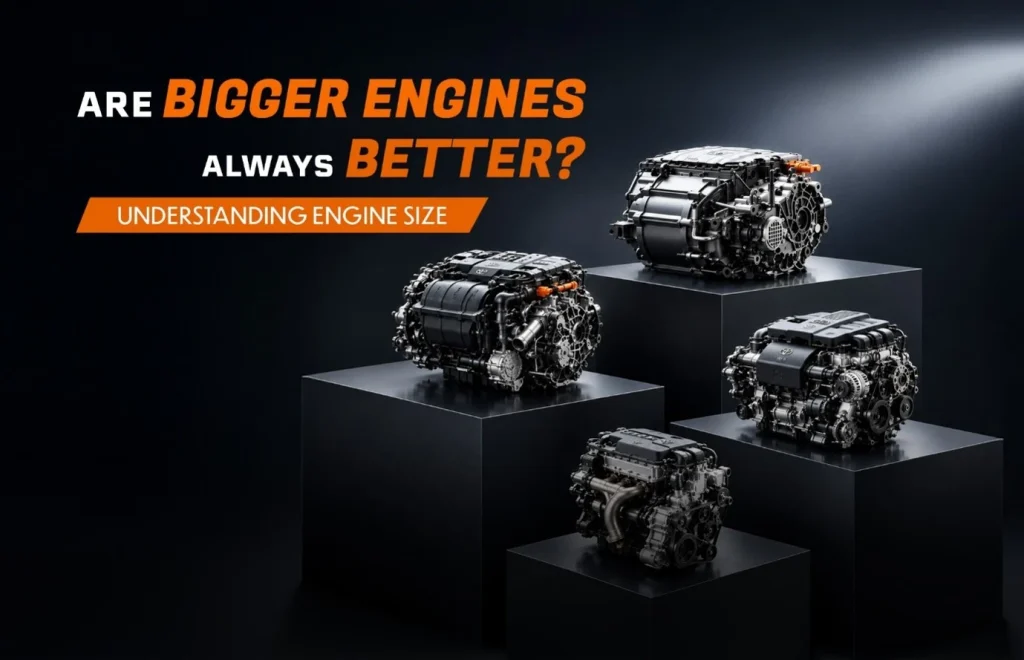
Engine size influences performance, torque, fuel consumption, emissions, and operating costs, but a larger engine is not automatically better. The right choice depends on vehicle weight, intended use, road conditions, climate, payload, and the overall powertrain.
For international vehicle buyers, these factors are particularly important because an exported vehicle may operate in very different environments from congested cities and highways to mountainous roads and demanding off-road conditions.
WHAT DOES ENGINE SIZE MEAN?
Engine size, or engine displacement, is the combined swept volume of all cylinders and is measured in litres (L) or cubic centimetres (cc). For example, a 2,298cc engine is commonly described as a 2.3-litre engine.
Displacement is determined by cylinder bore, piston stroke, and the number of cylinders. Greater displacement generally allows an engine to burn more air-fuel mixture per cycle, potentially producing more torque and power.
However, displacement alone does not determine performance. Turbocharging, compression ratio, direct fuel injection, valve timing, engine management, electrification, and transmission gearing can significantly change an engine’s output.
DOES A BIGGER ENGINE PRODUCE MORE POWER?
Traditionally, larger naturally aspirated engines produced more power and torque than smaller engines. Modern technology has changed this relationship.
A smaller turbocharged engine can achieve high specific output—power produced per litre of displacement— by forcing additional air into the cylinders. Hybrid systems can further improve performance by providing immediate electric-motor torque.
For SUVs and pickups, buyers should consider torque output and the RPM range at which maximum torque is available, rather than displacement alone. Strong low-RPM torque is particularly useful for towing, carrying heavy payloads, climbing steep gradients, and off-road driving.
ENGINE SIZE AND FUEL ECONOMY
Larger engines generally have greater fuel-consumption potential because they can burn more fuel. However, real-world efficiency depends on several variables, including:
- Vehicle weight and aerodynamics
- Turbocharging and fuel-injection technology
- Transmission type and gear ratios
- Two-wheel or four-wheel drive
- Engine load and operating RPM
- Driving speed, terrain, climate, and driving style
A modern downsized turbocharged engine can therefore deliver performance comparable to a larger naturally aspirated engine while reducing fuel consumption under appropriate operating conditions.
MATCH THE ENGINE TO THE OPERATING ENVIRONMENT
Engine selection should reflect how the vehicle will actually be used.
Smaller petrol or hybrid powertrains can be suitable for urban driving, where efficiency and low-speed operation are priorities. Larger petrol or diesel engines may be preferable for heavy payloads, towing, long-distance operation, or demanding terrain.
Export buyers should also consider ambient temperature, altitude, fuel quality, cooling-system capacity, emissions equipment, spare-parts availability, and local maintenance capabilities.
At higher altitudes, naturally aspirated engines lose performance because of reduced air density, while turbocharged engines can compensate for some of this power loss.
DIESEL, PETROL, OR HYBRID?
Diesel engines typically offer strong low-RPM torque and good efficiency under sustained loads, making them suitable for commercial vehicles, pickups, and long-distance applications.
Petrol engines generally provide smoother high-RPM performance and can be well suited to passenger vehicles and mixed driving.
Hybrid powertrains combine an internal-combustion engine with one or more electric motors. Regenerative braking recovers energy during deceleration, making hybrids particularly effective in stop-and-go urban driving.
WHAT SHOULD EXPORT BUYERS CONSIDER?
Engine displacement should be only one part of the purchasing decision. Buyers should compare power (kW/hp), torque (Nm), power-to-weight ratio, transmission, drivetrain, payload and towing capacity, fuel requirements, emissions systems, maintenance requirements, and expected operating conditions.
A smaller turbocharged engine may outperform a larger naturally aspirated engine, while a larger diesel may remain more appropriate for sustained heavy-duty operation.
IS A BIGGER ENGINE REALLY BETTER?
Not necessarily. Bigger engines provide greater displacement, not automatically greater suitability.
Modern turbocharging, direct injection, advanced transmissions, variable valve technology, and hybrid systems have reduced the importance of engine capacity as a standalone measure of performance.
The better approach is to evaluate the complete powertrain and its intended application.
At Forex Motors, vehicles are selected for buyers looking beyond borders. From powerful SUVs and pickups to efficient hybrids and practical passenger vehicles, the right engine is ultimately the one engineered for the road, load, climate, and operating conditions ahead.