
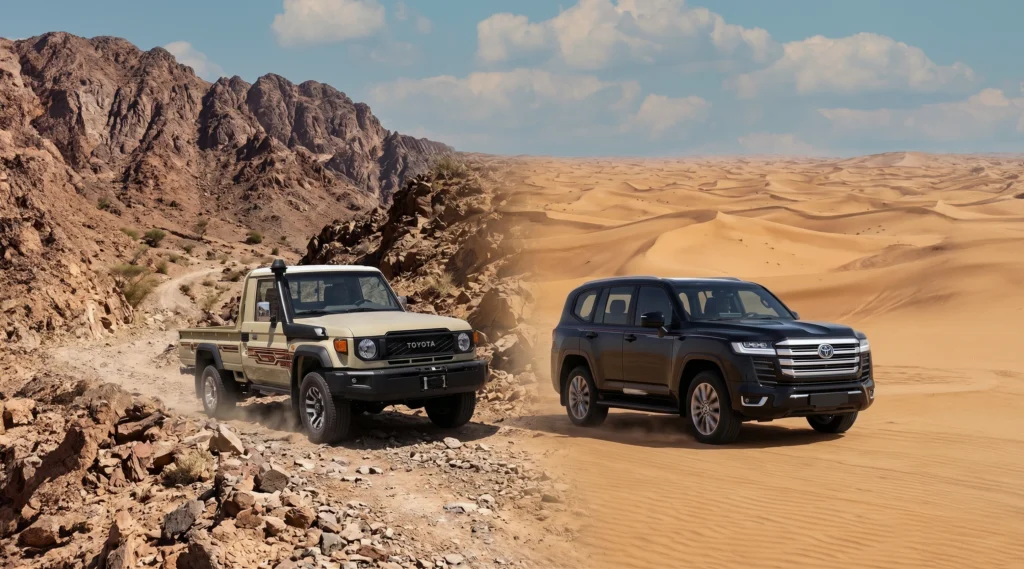
If you intend to purchase a Toyota, which will operate on rough and hard terrains all its life, then your choice is not only based on the name of the company, but more importantly on the location where you will use it. A truck which conquers the desert dunes might find it tough navigating mountains and vice versa. Knowing these things about your purchase beforehand will help you save a lot of money and troubles later.
Here’s how you can go about choosing the right Toyota model to operate on the rough terrain.
Understanding the Core Challenge: Sand vs Slopes
The desert and mountains put different demands on vehicles. In deserts, it involves floating through long and flat terrain that may have sand and loose soil. The mountain terrain requires that a vehicle provide power while driving uphill, as well as engine braking when going downhill.
A car designed to work best in one terrain will function quite well in another, yet if 80% of the time is spent in one terrain, then this should be considered.
For Desert Terrain: What Matters Most
1. Engine cooling and heat resistance
The desert climate puts the engine, transmission, and cooling system at their peak operating point. Temperatures often rise above 45 degrees Celsius, especially if you are tackling a sandy hillside or traveling on soft sands.
All Toyota vehicles designed for use in the Gulf countries are equipped with extra radiators, cooling fans, and even auxiliary transmission coolers. It’s the case with such models as Land Cruiser 300, Land Cruiser 79, and Hilux available on the market for the Middle Eastern countries. If you are planning to operate the vehicle in the Sahara, Arabian, or Kalahari desert, make sure you have GCC or Middle East specification.
2. Ground clearance and approach angles
However, in sand, clearance should be maintained to protect against the drag caused by the contact between the chassis and the surface and not to avoid obstacles. The Land Cruiser 300 has clearance of 230mm, while the Hilux and Land Cruiser 79 models have clearance levels of 215–220mm.
It is always good when clearance levels are high; however, more important than clearance levels themselves is maintaining a low center of gravity. This helps avoid rolling on sand dunes.
3. Tire footprint and flotation
Wide and aggressive tires that ensure weight distribution are needed for desert travel because you don’t want your car to sink. Some people deflate their tires a little (to about 15-18 psi) to maximize the surface area that comes into contact with the sand.
Both the Hilux and Land Cruiser 79 have enough space for larger tires. However, Land Cruiser 300 is equipped with an independent front suspension that provides better performance on the sand; at the same time, the process of deflating tires should be done more carefully.
4. Transmission and low-range gearing
Crawling through deep sand requires momentum, not crawling speed. You want a transmission that lets you hold second or third gear under power without constantly shifting. The Hilux’s 6-speed manual and 6-speed automatic both handle this well.
Low-range 4WD is essential for starting on soft sand or climbing dune faces, but once you’re moving, you’ll spend more time in high-range 4WD keeping momentum up.
5. Fuel range
Desert routes often run hundreds of kilometers between fuel stations. The Land Cruiser 300 has a 110-liter tank (some markets get an optional 138-liter setup). The Hilux and Land Cruiser 79 typically run 80–87-liter tanks, which is adequate for most routes but may require auxiliary fuel for long crossings.
Best Toyota models for desert terrain:
- Land Cruiser 300 (GCC spec): Top choice for serious desert work, maximum comfort, excellent cooling
- Land Cruiser 79 Double Cab Pickup: Bulletproof diesel, high payload, proven in Sahara crossings
- Hilux 2.8L Diesel 4WD: Best value, widely available parts, lighter and easier to recover if stuck
- Land Cruiser Prado (GCC spec): Good middle ground for mixed desert/urban use
For Mountain Terrain: What Matters Most
1. Power and torque at altitude
As you climb in elevation, the air gets thinner and engines lose power. Naturally aspirated engines can lose 10–15% of their power for every 1,000 meters of elevation. Turbocharged diesels, on the other hand, handle altitude much better because the turbo compensates for thin air by forcing more oxygen into the combustion chamber.
The Hilux 2.8L turbodiesel and the Land Cruiser 79’s 4.5L V8 turbodiesel are both excellent choices for high-altitude operation. They maintain torque and drivability even at 3,000+ meters, which is critical in the Andes, Himalayas, Ethiopian Highlands, or East African mountains.
2. Engine braking and descent control
What goes up must come down, and in mountains, your brakes are your lifeline. Overuse of friction brakes on long descents leads to brake fade and potential failure.
Diesel engines provide superior engine braking compared to petrol engines because of their higher compression ratios. The Land Cruiser models and Hilux equipped with manual transmissions give you direct control over engine braking by selecting lower gears.
Automatic models with Downhill Assist Control (DAC) or crawl control are helpful, but experienced mountain drivers often prefer the manual gearbox for the control it provides on steep, technical descents.
3. Suspension and articulation
Mountain roads and trails are uneven, rocky, and often rutted. You need suspension that can handle constant articulation without bottoming out or losing traction.
The Land Cruiser 79 uses a solid front axle with leaf springs — old-school, but incredibly durable and capable on broken surfaces. The Hilux uses independent front suspension, which gives a better ride on graded roads but slightly less wheel travel on extreme off-road sections.
For serious mountain work (mining access roads, remote construction sites, high-altitude field work), the Land Cruiser 79’s solid axle is the better choice. For mixed mountain and highway use, the Hilux provides a more comfortable daily drive.
4. Traction and 4WD systems
On steep mountain grades, especially in mud, loose gravel, or snow, you need consistent traction on all four wheels. Locking differentials are a game-changer here.
The Land Cruiser 79 and some Hilux variants offer a rear differential lock as standard or optional. The Land Cruiser 300 and Prado have electronic traction control and multi-terrain select systems that brake spinning wheels and redirect torque, which works well but isn’t quite as reliable as a mechanical locker in extreme situations.
If you’re regularly climbing 30%+ grades on loose surfaces, a rear locker is non-negotiable.
5. Cooling (yes, still important)
Mountains may be cooler at the summit, but climbing a steep grade under load generates enormous heat. Your engine is working at maximum torque for extended periods, and your transmission is being asked to hold low gears while moving slowly.
Transmission cooling is critical. Heavy-duty automatic transmissions with auxiliary coolers (common on GCC-spec models) handle mountain work better than base-spec vehicles.
6. Braking performance
Repeated heavy braking on descents is hard on any braking system. Larger brake rotors, ventilated discs, and quality brake fluid matter.
The Land Cruiser 300 and Prado have excellent braking systems with standard ABS and EBD (Electronic Brakeforce Distribution). The Hilux and Land Cruiser 79, while simpler, still offer solid, serviceable brakes that respond well to upgrades if needed.
Best Toyota models for mountain terrain:
- Land Cruiser 79 4.5L V8 Turbodiesel: Unmatched at altitude, solid axles, rear locker, built for punishment
- Hilux 2.8L Diesel 4WD (Manual): Excellent torque, reliable, more maneuverable on tight switchbacks
- Land Cruiser Prado 2.8L Diesel: Comfortable for long climbs, great mix of tech and durability
- Land Cruiser 300 (if budget allows): Top-tier power and safety systems, ideal for high-altitude touring
What If You Need Both?
If your work or travel takes you across both deserts and mountains, think trans-Africa routes, Middle East to Central Asia overland journeys, or oil and gas operations that span varied terrain, you need a vehicle that can handle both without compromise.
The all-rounder choice: Toyota Land Cruiser 79 Double Cab Pickup
It’s not the most comfortable, it’s not the most modern, but it’s the most capable across the widest range of conditions. Proven in the Sahara, the Himalayas, the Australian Outback, and everywhere in between. GCC-spec models come with the cooling, the gearing, and the durability you need for both extremes.
The comfortable all-rounder: Toyota Land Cruiser 300 or Prado
If you need to carry clients, work as a daily driver, or simply want modern features and comfort, the Land Cruiser 300 or Prado (both in GCC spec) will handle both deserts and mountains very well. You sacrifice some of the extreme ruggedness of the 79, but you gain refinement, safety tech, and a much more pleasant driving experience.
The budget all-rounder: Toyota Hilux 2.8L Diesel 4WD
For individual buyers, small businesses, or NGOs working across mixed terrain, the Hilux is unbeatable for value. It doesn’t have the raw capability of the Land Cruiser 79 or the luxury of the 300, but it will get the job done in 90% of conditions, and parts and service are available almost everywhere on Earth.
Specification Checklist: Questions to Ask Your Dealer
Before you finalize your order, confirm these details with your exporter or dealer:
- Is this a GCC-spec or Middle East-spec vehicle? (Critical for desert cooling and heat resistance)
- Does it have an auxiliary transmission cooler?
- What is the fuel tank capacity?
- Does it have a rear differential lock? (Essential for serious mountain or off-road work)
- What is the GVWR (Gross Vehicle Weight Rating)? (Tells you how much load it can safely carry at altitude)
- Is the turbocharger variable geometry or fixed? (Variable is better for altitude performance)
- Are the brake rotors ventilated? (Necessary for mountain descents)
Final Word: Match the Vehicle to the Mission
There is no single “best” Toyota for all terrain. The best vehicle is the one that matches where you’ll actually be driving 80% of the time.
If you’re running routes through the Empty Quarter, prioritize cooling, flotation, and fuel range. If you’re hauling equipment to mining sites at 4,000 meters, prioritize turbo diesel torque, engine braking, and a rear diff lock.
And if you need help spec’ing the right model for your operation, that’s exactly what Forex Motors does. We’ve been exporting Toyotas from Dubai to every environment on Earth for years, and we know which configurations work where.