
If you’ve been shopping for a new Toyota recently, you’ve probably come across the term “Toyota Safety Sense” on a spec sheet or in a dealer brochure. It sounds impressive, but for many buyers, especially those purchasing vehicles for work, export, or use in developing markets, the real question is whether it actually makes a difference where you’re driving.
This guide breaks down exactly what Toyota Safety Sense is, how each feature works in plain language, and whether it’s worth paying for based on your specific situation.
What Is Toyota Safety Sense?
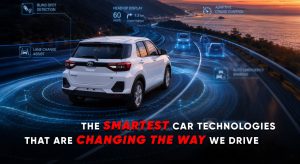
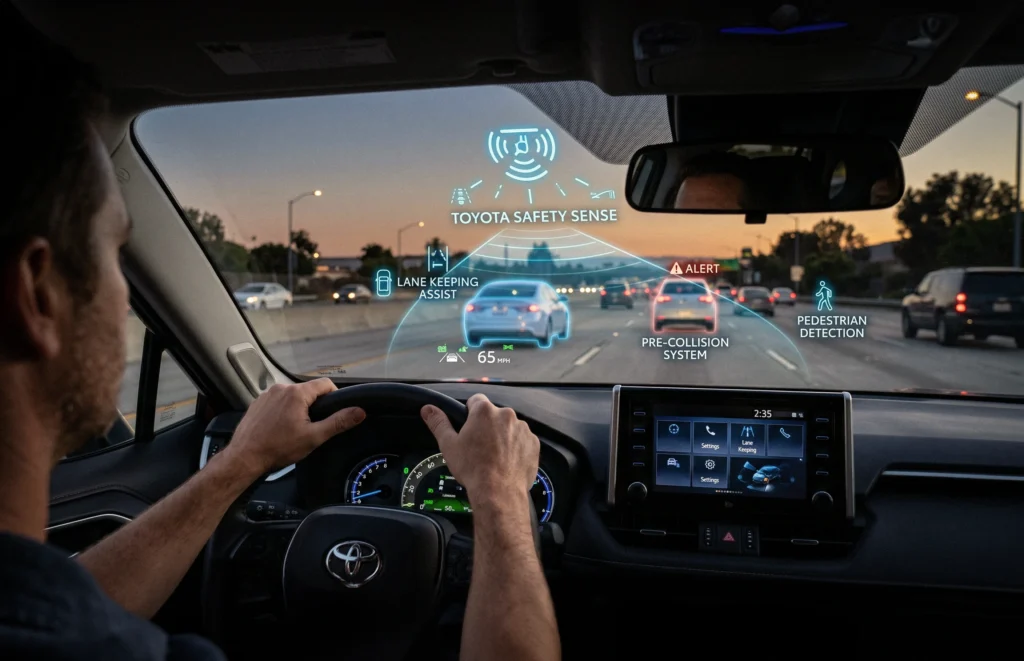
Many of Toyota’s models come with a set of active safety features called Toyota Safety Sense, or TSS for short. Toyota combines these parts into a single system that is either standard or optional based on the model and market, rather than selling them separately.
The crucial term in this context is “active.” Toyota Safety Sense is intended to help you prevent incidents in the first place, in contrast to passive safety measures like seatbelts and airbags, which protect you when an accident occurs. It accomplishes this by monitoring the road ahead and responding to possible hazards using a combination of cameras, millimeter-wave radar sensors, and onboard CPUs.
Toyota first introduced the system in 2015 and has since updated it through multiple generations. The current version found on newer models is called Toyota Safety Sense 3.0, and it is significantly more capable than the original.
The Core Features Explained
1. Pre-Collision System (PCS)
This is the most prominent and possibly most significant component of Toyota Safety Sense. The Pre-Collision System uses a camera and radar to continuously scan the road ahead. The system reacts gradually if it detects that you are getting close to a car, a pedestrian, or, in more recent versions, a cyclist and determines that a collision is likely.
It first warns the driver both visually and audibly. In order to maximize the efficiency of any braking the driver makes, the system offers brake help if the driver does not react. The system automatically applies the brakes if the driver doesn’t react and a collision looks likely.
In real-world terms, this can be the difference between a serious accident and a near miss, particularly in situations where the driver is momentarily distracted, fatigued, or reacting to something else on the road.
It is worth noting that PCS is not a guarantee against all collisions. It works best in clear daylight conditions and at moderate speeds. Heavy rain, fog, dust, and low light can reduce its effectiveness. In desert sandstorms or dense highland fog common in many markets where Toyotas operate the system may not perform as well as it would on a clear European motorway.
2. Lane Departure Alert (LDA)
Road markers are monitored by the lane departure system using the front camera. The device alerts the driver if the car starts to veer out of its lane without activating a turn signal. In certain versions, it can also gently adjust the steering to return the car to its lane.
This feature works well on metropolitan roadways and well-marked highways. The lack of lane markers for the camera to interpret makes it difficult for the system to operate consistently on rural roads, muddy tracks, or roads with faded markings, which are especially frequent throughout Africa, portions of the Middle East, and South and Southeast Asia.
If the majority of your driving happens on unmarked or poorly marked roads, lane departure alert provides limited practical value in those conditions. It will, however, still work when you’re driving on highways or in urban areas.
3. Automatic High Beam (AHB)
In response to approaching traffic and vehicles in front of it, this feature automatically adjusts between high and low beam headlights. It turns on high beams for optimal visibility when it detects no other vehicles. In order to prevent dazzling other vehicles, it drops to low beam when it detects headlights or tail lights.
This is really helpful for long-distance truckers traveling hundreds of kilometers at night on dim rural roads, which is a reality for many drivers in East Africa and Central Asia. It minimizes driver fatigue on lengthy trips by keeping your high beams on as much as feasible without requiring frequent manual switches.
4. Radar Cruise Control (Dynamic Radar Cruise Control)
Traditional cruise control holds a fixed speed. Dynamic Radar Cruise Control goes further by using the radar to monitor the vehicle ahead and automatically adjusting your speed to maintain a safe following distance. If the car ahead slows down, your vehicle slows too. When the road clears, it accelerates back to your set speed.
This greatly reduces discomfort on lengthy highway trips, such as transcontinental routes, motorway driving, or lengthy lengths of level pavement. The continual speed adjustment is done automatically, but the driver still needs to steer and pay attention.
It can feel invasive on congested city highways with plenty of lane changes and stop-and-go traffic, and experienced drivers frequently turn it off. It is completely disabled in dirt or off-road situations, which makes sense.
5. Lane Tracing Assist (LTA)
Available on newer TSS 3.0 vehicles, Lane Tracing Assist works alongside Radar Cruise Control to keep the vehicle centred in its lane on the highway. It makes small steering inputs to maintain position. This is a step toward semi-autonomous highway driving, not full self-driving.
Like Lane Departure Alert, it relies on visible lane markings to function. Without them, it deactivates. It’s a comfort and fatigue reduction feature primarily designed for long motorway journeys.
Which Toyota Models Come with Toyota Safety Sense?
Toyota Safety Sense has been progressively rolled out across the range. In most markets, you’ll find it on:
- Land Cruiser 300 – TSS 3.0 standard across all grades
- Land Cruiser Prado – TSS standard on most grades
- Hilux (newer facelifted models) – TSS available on higher grades depending on market
- Fortuner – TSS available on upper grades in select markets
- Corolla, Camry, RAV4 – Standard in most markets
Notably, the Land Cruiser 79 Series does not come with Toyota Safety Sense. It is a purpose-built utility vehicle with a simpler, more robust electronics philosophy. If you work in mining, construction, remote agriculture, or humanitarian operations, this is often seen as an advantage rather than a disadvantage — fewer electronic systems means fewer things that can go wrong in remote conditions far from a dealer.
Do You Actually Need It?
This is where honest advice matters more than marketing language. The answer depends entirely on how and where you drive.
Toyota Safety Sense is worth it if:
You spend significant time driving on well-maintained tarmac roads with proper lane markings. Long highway journeys between cities, daily commuting in urban environments, and family road trips all benefit from the system’s core features. The Pre-Collision System in particular provides a meaningful safety layer for any driver regardless of road quality.
You are buying for a market where drivers regularly face highway fatigue. Radar Cruise Control and Lane Tracing Assist are genuinely fatigue-reducing on long, monotonous highway routes. If your drivers are covering 500km+ days on tarmac roads, these features reduce the risk of accidents caused by tiredness.
Your organisation requires modern safety compliance. Some government agencies, international corporations, and NGOs have procurement policies that require a minimum level of active safety technology on fleet vehicles. TSS helps meet those requirements.
Toyota Safety Sense is less critical if:
Most of the time, you are driving off-road, on unpaved roads, or in areas without road markings. In these circumstances, most TSS features either deactivate or perform poorly. A rear differential lock, a heavy-duty suspension raise, a snorkel, or long-range fuel tanks are examples of mechanical changes that can be a better use of your money.
You are operating in environments with extreme dust, sand, fog, or heavy rain as a daily condition. The radar and camera systems that power TSS are less reliable in poor visibility and can generate false warnings or fail to detect hazards accurately. In a sandstorm in the Sahara or heavy monsoon rain in Southeast Asia, the Pre-Collision System may not perform as its engineers intended.
You need the simplest, most serviceable vehicle possible. In remote areas where Toyota service centres are hundreds of kilometres away, simpler electronics are easier to diagnose and repair. A Land Cruiser 79 without TSS is, in many ways, better suited to extreme remote operation precisely because its systems are straightforward.
You are buying for agricultural or utility work. A farmer hauling fertilizer across muddy field tracks, a mining company running equipment access roads, or a construction firm on an unfinished site will get very little daily benefit from lane departure alerts and radar cruise control.
Final Thoughts
Toyota Safety Sense is a well-engineered, genuinely useful system, but it’s not magic, and it’s not equally valuable for every buyer. Think honestly about where your vehicle will be driven most of the time, who will be driving it, and what conditions they’ll face regularly.
For fleet managers, the Pre-Collision System alone is worth having simply as an extra layer of protection for drivers who spend long hours on the road. For buyers going deep into remote terrain, don’t let the absence of TSS on a Land Cruiser 79 put you off; the vehicle’s mechanical capability matters far more in that context than any driver assistance technology.